April 20, 2026Focus on Parliament
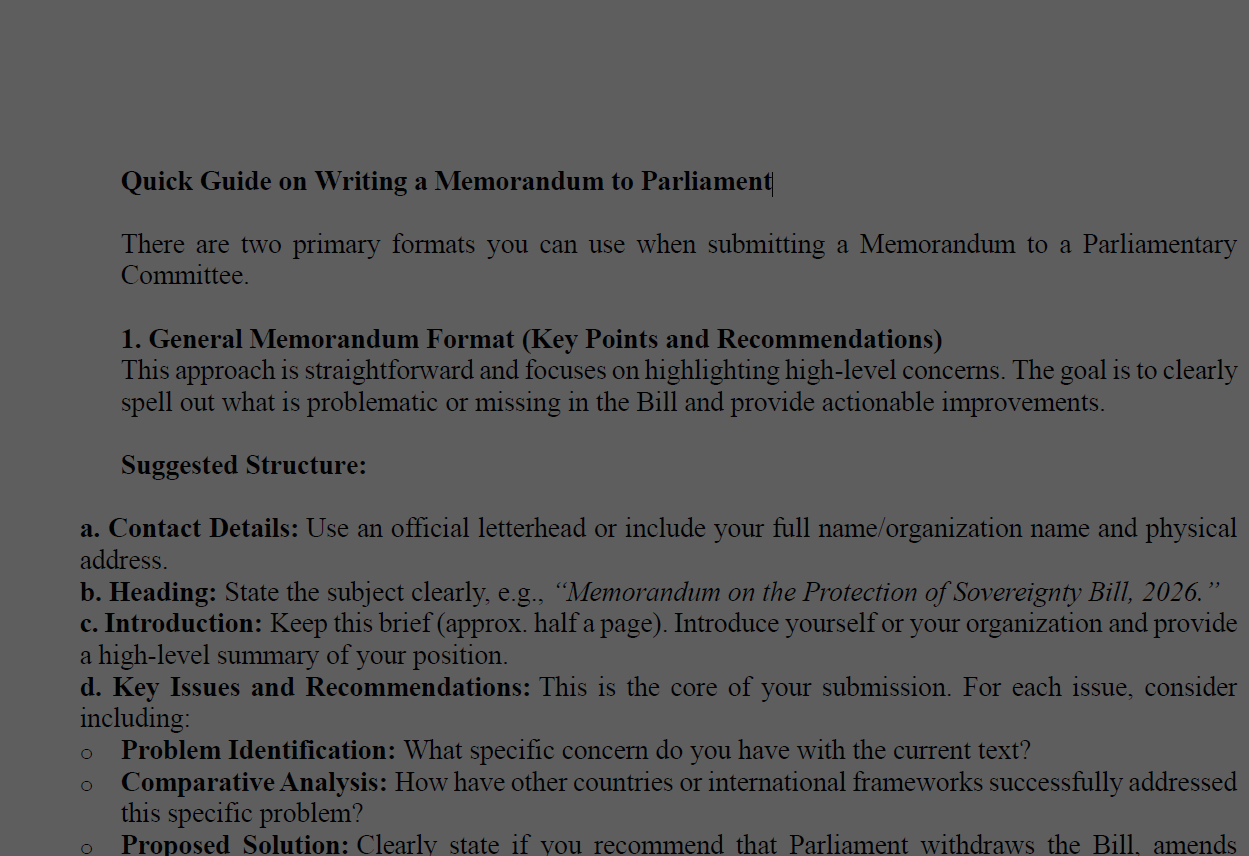
Quick Guide on Writing a Memorandum to Parliament.
This document provides guidance on preparing two types of memoranda to Parliament—one high-level summary and one detailed clause-by-clause analysis—focused on legislative concerns and recommendations.
Overview of Memorandum Formats
- The general format emphasizes key issues, problems, international comparisons, and actionable recommendations, supported by research and legal references. It includes a structured cover page, introduction, key issues with suggested solutions, and a conclusion.
- The technical format involves detailed, line-by-line review of the Bill, identifying specific clauses, issues, recommendations, and justifications, suitable for legal scrutiny.
Key Components of the General Memorandum
- Contact details, clear subject heading, and a brief introduction establishing the submitter’s identity and position.
- The core section highlights major issues such as legal redundancy, over-broad definitions, and constitutional violations, with specific examples like the reclassification of citizens abroad, vague terms on foreign interests, and overly broad criminalization of economic activities.
- Recommendations include withdrawing problematic clauses, amending definitions to focus on security threats, and replacing administrative approval requirements with transparency measures.
- The conclusion summarizes the stance that the Bill, in its current form, undermines constitutional rights, creates legal ambiguities, and risks economic and democratic stability.
Key Components of the Clause-by-Clause Analysis
- The detailed review assesses each clause’s legal and practical implications, recommending deletions or modifications to ensure constitutionality and clarity.
- Examples include narrowing the definition of “foreign agent” to avoid targeting legitimate activities, removing provisions that reclassify citizens abroad as foreigners, and eliminating vague or overly broad criminal offenses like “economic sabotage.”
- Specific clauses such as those requiring cabinet approval for policies or prior foreign funding approval are critiqued for violating constitutional rights and creating unnecessary bureaucratic hurdles.
- Justifications focus on protecting rights, ensuring enforceability, and aligning with existing legal frameworks.
Overall Emphasis
- Both formats aim to ensure legislative clarity, protect constitutional rights, and prevent misuse or overreach.
- The documents advocate for thorough consultation, legal precision, and alignment with international standards and domestic laws to safeguard democracy, economic stability, and individual freedoms.
DOWNLOAD THE QUIDE HERE: Quick guide on writing memorandum to parliament