By Dr. Sarah Bireete
The appointment of serving military officers to cabinet continues to raise constitutional questions under Articles 113 and 208 of the Constitution.
After the enactment of the 1995 Constitution, serving Soldiers were required to first resign from the army before taking up their positions in Cabinet. The test for this safeguard was the appointment of Gen. Jeje Odongo in 1996 as Minister of State for Defence. He had to first retire from UPDF.
Article 208 establishes the Uganda People’s Defence Forces (UPDF) as a non-partisan, professional, disciplined and national institution subordinate to civilian authority. The purpose of this provision is to ensure that the military serves all citizens equally and remains insulated from partisan political competition. In a constitutional democracy, the military is expected to defend the state and uphold the Constitution, not to participate in political contests or align itself with particular political interests.
Article 113, on the other hand, provided that the President can appoint ministers from amongst MPs and any other citizens qualified to be MP. It was argued that this provision qualifies UPDF MPs to be appointed to Cabinet; an argument that was advanced in 2013 after the controversial appointment of Gen. Aronda as a minister of Internal Affairs as a serving soldier.
Further constitutional questions arise when serving military officers who are not UPDF representatives in Parliament are appointed to Cabinet. Such appointments place active members of a constitutionally non-partisan institution into offices that require overt political engagement. The result is a potential conflict between the duty of political neutrality under Article 208 and the political responsibilities associated with ministerial office under Article 113 of the Constitution.
Continuous military participation in legislative affairs through designated military representatives in Parliament in a multiparty suspension presents a significant constitutional challenge. Appointing additional serving officers to Cabinet outside this framework is an expansion of the military political role beyond what the framers of the Constitution contemplated.
Such appointments blur the distinction between civilian and military authority. One of the cornerstones of constitutional governance is the principle of civilian control over the armed forces. When serving officers simultaneously occupy senior military positions and political executive offices, the separation between military command structures and civilian political leadership becomes less clear. The military is becoming increasingly intertwined with partisan governance.
Further more, the legitimacy of a professional army depends in part on the public perception that it serves the nation rather than a political party or government. When serving officers become the public face of controversial government decisions, criticism directed at government policy may increasingly be directed at the military institution itself.
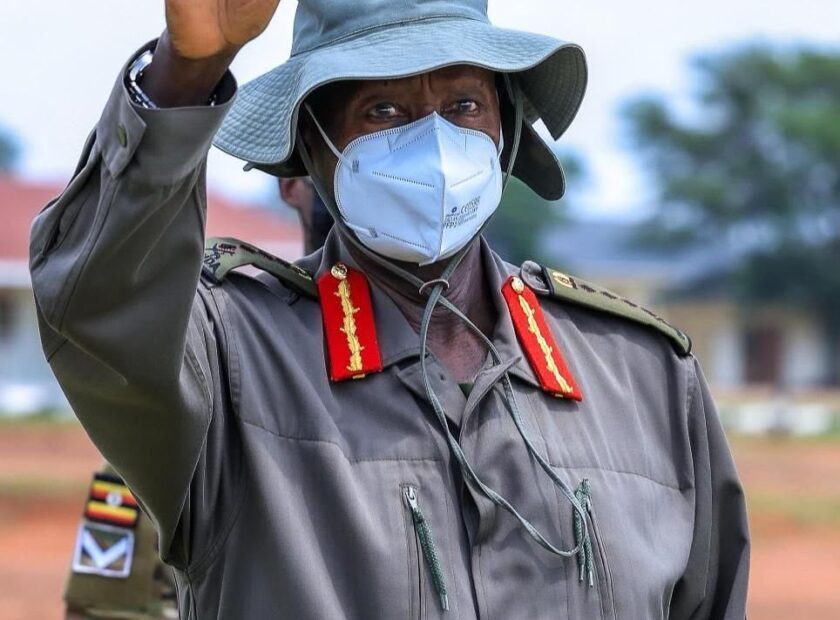
Gen. Katumba Wamala joined cabinet in 2017 when he was an MP representing UPDF in Parliament, a post he retained in the 11th Parliament. The camel applies to Gen. Wilson Mbadi when he was appointed to cabinet in 2024. The two Generals are not UPDF MPs in the 12th Parliament. Their appointment to cabinet before retirement can’t benefit from the Gen. Aronda controversial shield of being MPs, as per Article 113 of the Constitution.
Parliament whose main function is to protect the constitution and promote constitutional governance has a duty to ensure that the two generals exit UPDF before they are approved as ministers in the next cabinet.
As Uganda continues to strengthen its democratic institutions, adherence to both Articles 113 and 208 remains essential to safeguarding civilian rule, constitutionalism and public confidence in armed forces.